Revu A Midsummer Night’s Dream
“A Midsummer Night’s Dream” Poster
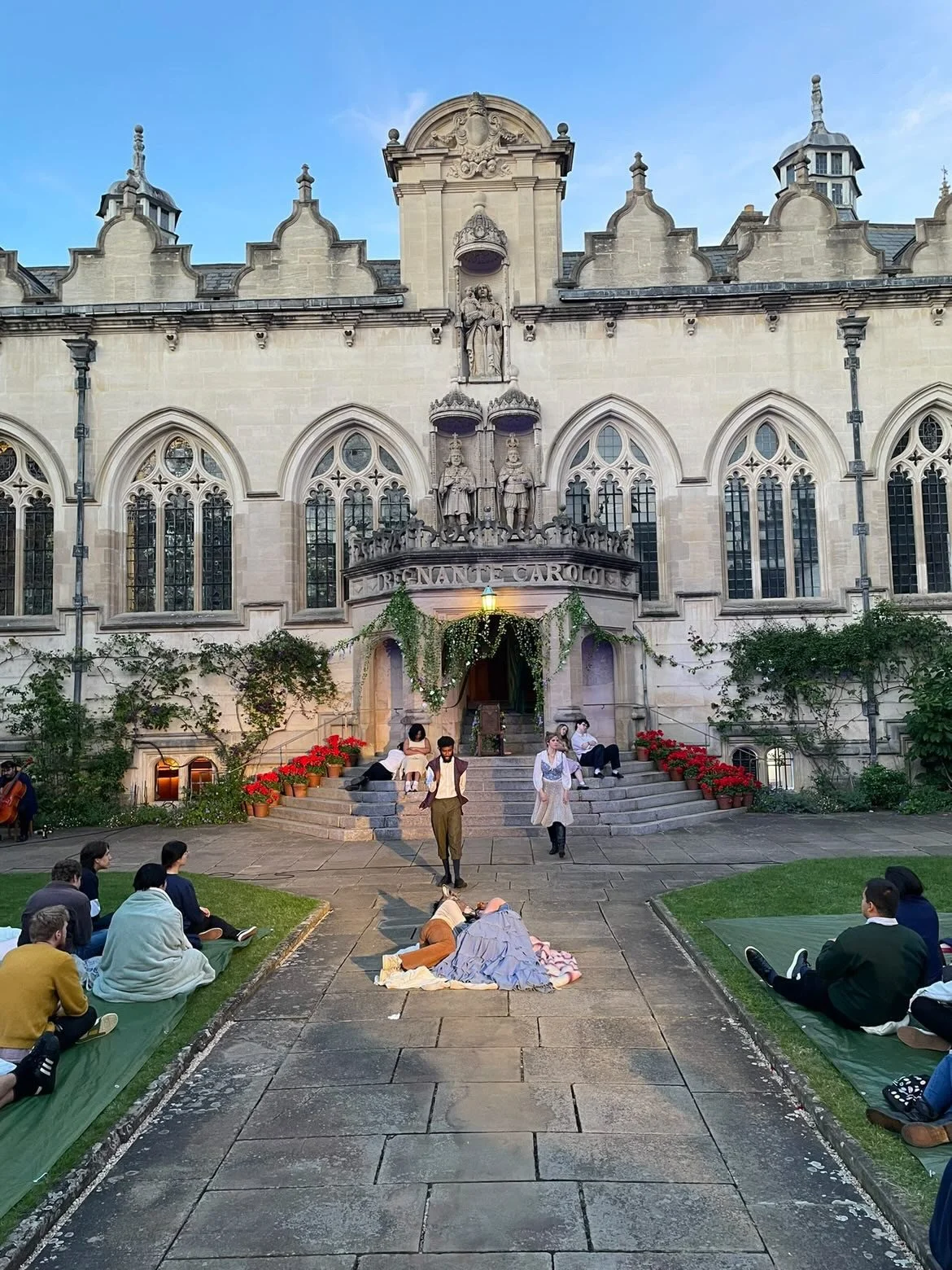
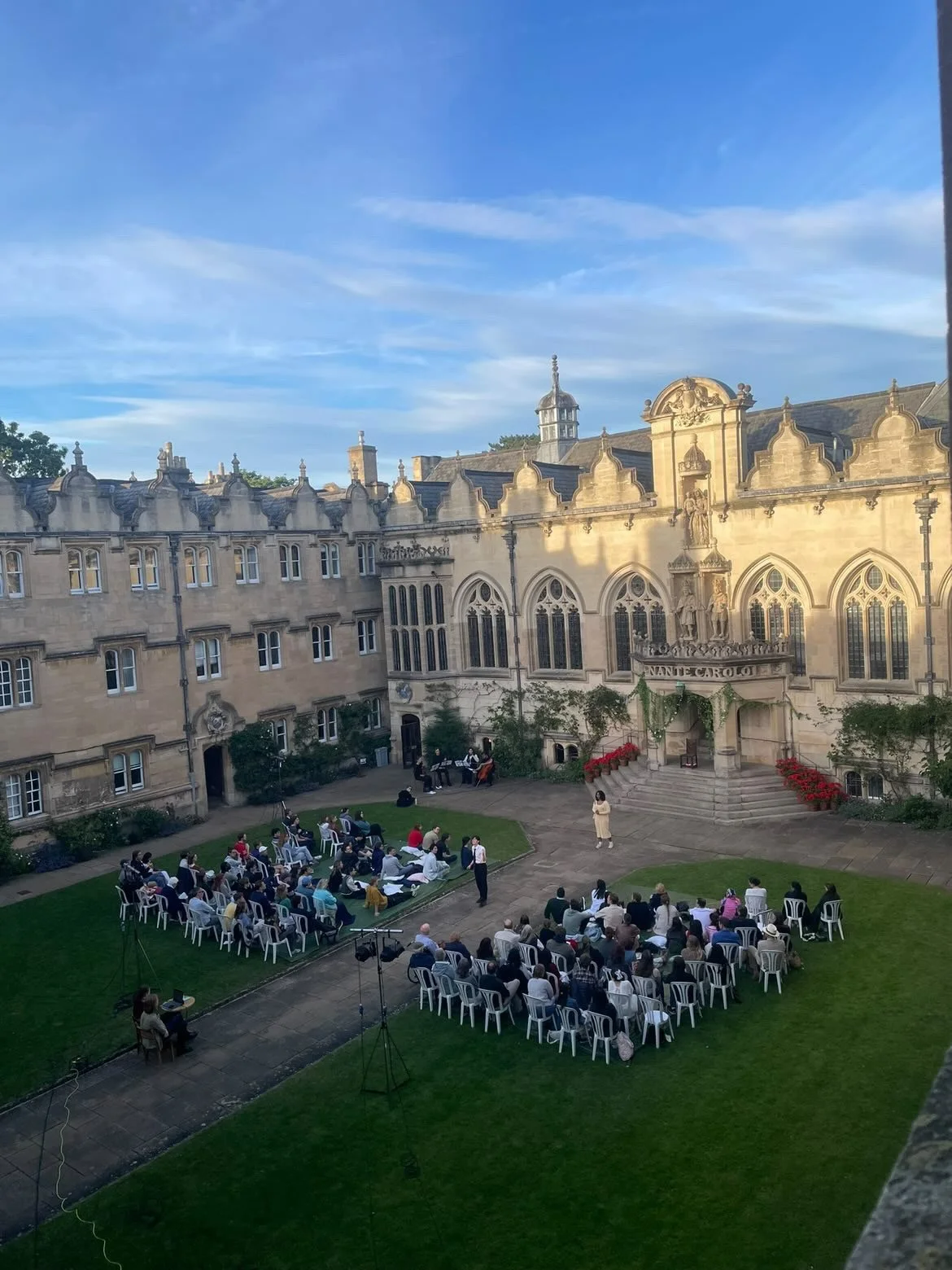
There are only few things more Oxfordesque than a Shakespeare’s comedy in a college garden. Oriel’s quad feels like a perfect set for Midsummer night’s dream, with its stairs, columns and greenery.
The play’s plot is notoriously convoluted and dreamy. Cheers to director Maggie Kerson and the rest of production team, who dive fully into playfulness and turn the practical limits of student productions into comedic possibilities. So, we get Titania and Oberon played by the same performers as Theseus and Hippolyta, characters rushing across the quod and hiding behind columns, Lysander and Demetrius in deconstructed suit and ties sparring with branches. With a good old sprinkle of gender bent casting that can never hurt.
“A Midsummer Night’s Dream”
All the acting is clearly a labour of love and, even when acerbic, it doesn’t get lost (forgive the pun.) The main quartet of performers offers us earnest portraits of sweet Hermia (Niara Milsap), enamoured Lysander (Esther O’Neill), arrogant Demetrius (Camille Branch) and scorned Helena (Alex Coupland.) Titania/Hippolyta (Sophia Valmalette-Wright) and Oberon/Theseus (Noah Rudder) oscillate nicely between wise Athenians and petty fairy royalty. Puck (Jess Phillips) is as mischievous and lovable as the text commands. Yet the laurel goes to Amaka Ihejirika, making a dazzling Nick Bottom, going from exaggerated speak to on-time slapstick, and making the audience burst into laughter over and over.
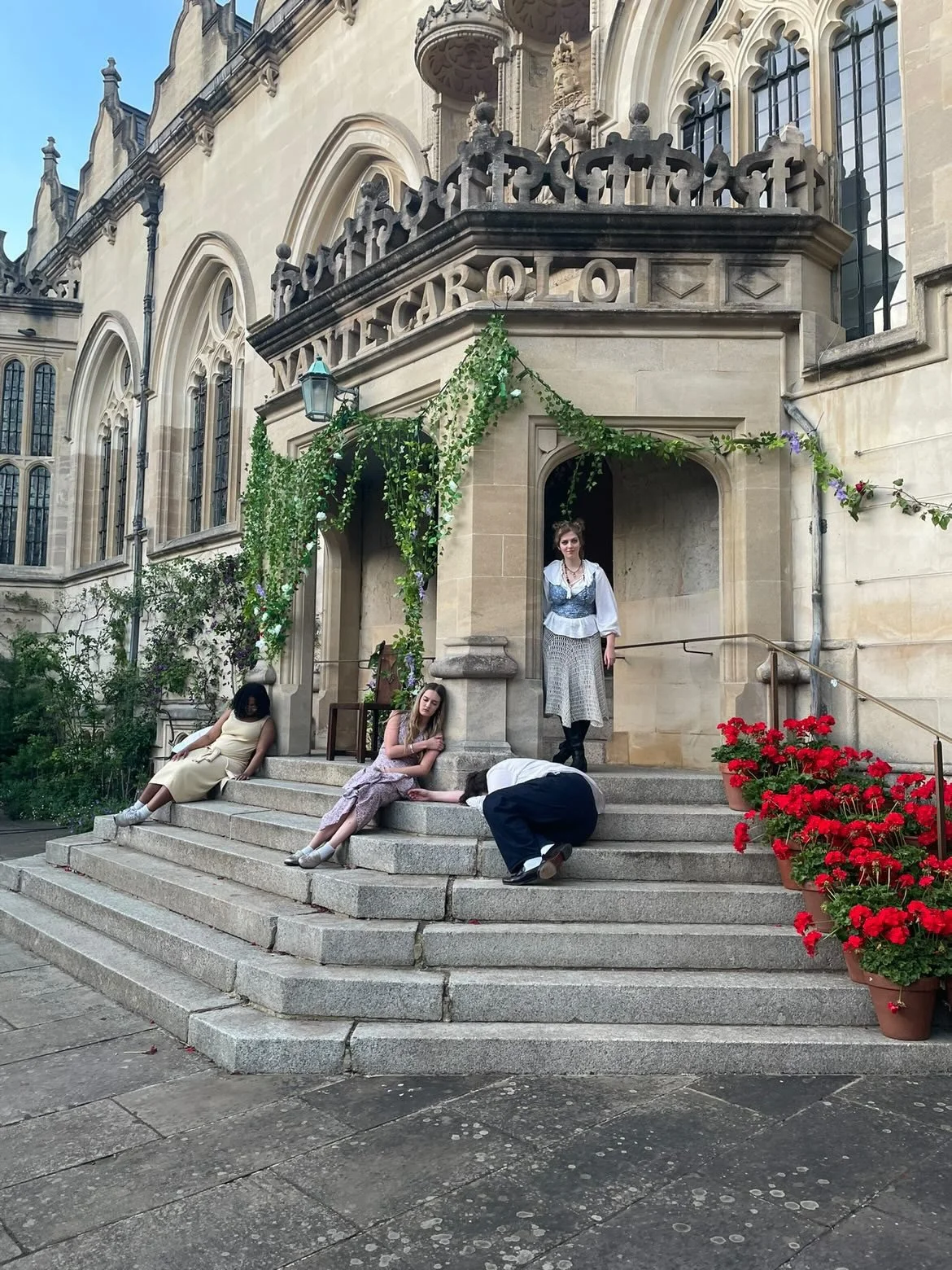
Shoutout to costume design by Charlotte Ward: not only it perfectly mirrors the hierarchies of the play, from the overt elegance of Oberon and Titania (hard to think of a dress more fitting to fairy queen than the ethereal blue long fabric chosen) to the plain clothes of Quince’s company. Light design and set design are also spot-on in their minimalism, perfectly complementing the college architecture. At the beginning of act 4, warm light envelopes the faces of the cast, lying on the staircase of Oriel quad, just awakening from their slumber. Meanwhile, twilight descends on the audiences, a sliver of moon appearing in the almost-night sky. This is open-air theatre at its best, when the landscape chosen blends with the performance.
“A Midsummer Night’s Dream”
This production has all the dedication of student theatre, as well as some of the flaws. At times I hoped that the performers would project more their voices or speak more slowly, especially without the resonance of a closed space. While at times the fast pace matches well the whirlwind of scenes, twisting and turning and losing itself, it could have been nice to have some calmer intervals. But garden plays have practical constraints, especially in a May that’s still too cold for comfort.
Despite everything, what stands out in Midsummer night’s dream is the contagious joy of cast and crew. Adapting the bard is no small challenge, and it’s always lovely to see the challenge accepted with enthusiasm and levity.

3/5 Stars
By Jude Parrotta
“A Midsummer Night’s Dream”