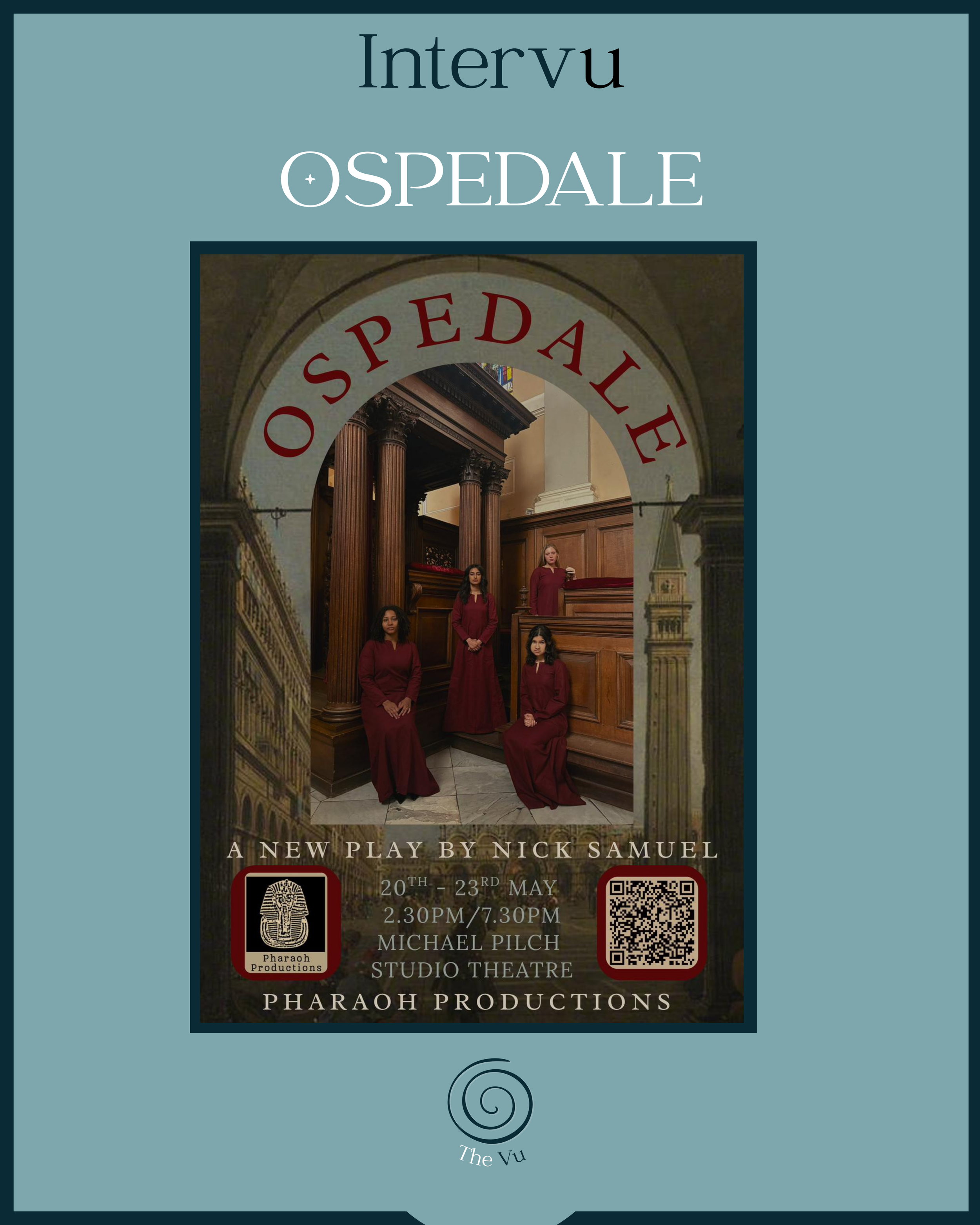
Intervu Ospedale
“Reformed” Rehearsal Photos
On a relatively sunny Monday, I sit down outside Common Ground with writer, composer, actor, and friend Nick Samuel to talk about his new play, Ospedale. Having read the play, which Samuel is also directing with his student company Pharaoh Productions, I was eager to dive into his writing style, his historical research, and the synthesis of his loves for theatre and music.
As with my first interview, questions/comments from me are in bold, and Samuel's responses are italicized.
Hello Nick!
Hi! Fancy seeing you here!
Yes, and I happen to have some questions for you! So, to start off, tell the people reading: who are you, about yourself – why do we need to be interested in Nick Samuel as a practitioner?
Yes, I'm... Nick... I've forgotten everything about myself. I'm a third-year musician at St. Anne's and I mostly identify as a composer and playwright. There are parallels in those two things I do, and the result is that there's sort of a lot of intermixing in the way I go about those things. I refuse to stick to one discipline.
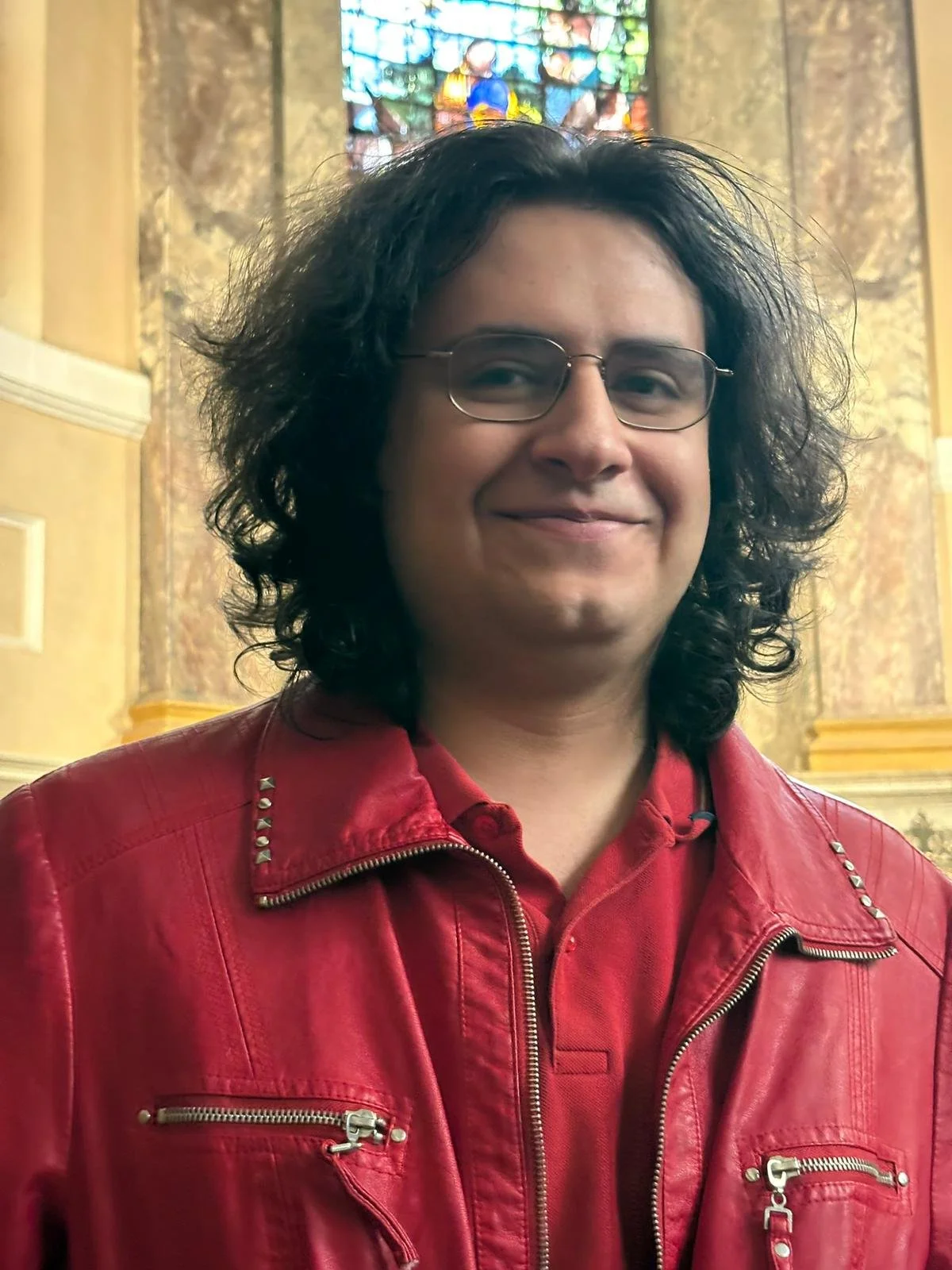
“Nick Samuel”
Yeah, and we're obviously here to talk about your new play, Ospedale. Tell us a bit about Ospedale, tell us about the overarching story to start with.
Where to start? Ospedale is set in Venice in 1710 in an institution called the Ospedale della Pieta, which was one of four institutions called grand hospitals, that were basically orphanages-slash-music-schools. It's the most famous one - it was the Ospedale. Basically they taught orphans music and did concerts and that was how they continued to be able to fund it. The Ospedale is the one where Antonio Vivaldi (of Four Seasons fame) was employed for a bit.
I went to Venice around 2018, and then my parents went to Venice at different times and it was actually their idea that this could serve as a play. By the time the events of the play happen in 1710, the hospital had become quite corrupt. It had very much stopped being about anything religious or musical and it was basically: "how can we get as much money as possible at the expense of the girls we're taking in?" That's the main conflict in the play, which is actually following these four girls when Vivaldi joins.
Now, as you were mentioning just now, this is obviously a kind of historical drama, or historical setting. It's obvious you've done a lot of historical research into the real Ospedale. What was your experience of doing that historical research and how did that affect the way that you wrote the play and about this institution?
That's a really good question. So, to put it into some context, I've had the idea for the play for ages. I started doing research in March of last year, and I was researching up until I started writing in October. I started writing as Your Funeral [Samuel's last play] was premiering. So the research took so much more time, by far. There was just so much ground to cover, and I very much let the research teach me what I wanted to happen in the narrative. I had a vague idea of how the Ospedale works, what kind of thing goes on there, and some of its problems, but I didn't know enough about it to come up with a plot.
As I was reading, this theme of corruption in the institution kept coming up and I was like, "okay, that's something I can work with." The more I read, the more things that I could use in the play appeared to me. There was a lot more that I could've included that I didn't, as well.
Well, it's quite a restrained play in a way, because it follows just four characters (and of course, although you never show us Vivaldi, as you say in your foreword he is the kind of villain and feels like a character). It's quite restrained in that you didn't include too much. Without giving anything away, were there historical precedents for some of the fates that befall the girls in the play?
Yeah, so the the girls themselves are all named after real girls who were in the Ospedale. There's a record by a guy called Mickey White, I think, who basically has a register of all of the the girls in one performance in 1715. On this list, he's written when they were born, whether they were married and when they died.
So of the four characters, Marcolina, who's Priora [the lead sister of the orphanage] in the play, was the Priora at that time. She died when she was 80, I think, and never got married, so you could assume she was there for her whole life. Clementia was a real violinist, Geltruda was a real continuo player. The interesting one is Fiorina. On that list, Fiorina is one of the youngest people there. In 1715 she was about 14-16, and then she died when she was about 24. She died the youngest. Venice was full of syphilis, and it was actually not very difficult for girls to sneak out of the Ospedale, or for them to sneak blokes in, to have their 'amorous escapades' as one of the books I was reading describes them.
You touched on this earlier, but you're also a composer, as well as a writer and sometime actor. Your first staged play, Your Funeral, was based on a song, and Ospedale is obviously about music. So I think it's safe to say you like to mix your music and your theatre. How did your knowledge of music and composing affect the writing of Ospedale, which is about music and composing.
It really did help. On the one hand, this is music in 1710 in Italy, which is a very, very different thing. Welfare Officer for the show, Sam Oliver-Sherry, knows all about exactly this kind of music. Very often I went to Sam and asked, "how does this work?," because he just knows so much more about it than I do. On the other hand, it helped because I know the life of a musician. I have been a performer as well, and I know what it feels like when you're practising something and it's just "not fast enough." Also, I know about Geltruda being very passionate about her composing, because that's quite a close link to me as well.
How is Ospedale either in continuity with or different from your previous work? How does it fit into the Nick Samuel cinematic universe?
I mean, the setting is so different because it wasn't my idea originally. The thing I'm most drawn to is the act of storytelling, in the simplest terms. I'm not really interested in political or didactic theatre. I think it's important, but it doesn't call to me specifically. For me, it's very much about realness, naturalism, and my plays are emotionally driven. A big thing with Your Funeral is that both characters are completely dictated by their emotions and they're very bad at taking a step back and being like, "is this a sensible thing that I'm doing?" It's a similar thing in Ospedale where the girls are ready to explode from all the pressure of the environment. There's something very undiluted and raw about the way they act.
It's people facing changes to their lives, isn't it? In Ospedale there's the threat always of marriage, or death, or being a prostitute. In Your Funeral, there's the threat of death or living with grief. I mean, the obvious thing is they both end in quite dramatic, emotional, sad ways. You don't write pastoral comedies...
I haven't done yet! There's something very special about going to the theatre, and you come out, and there's a sensation of something very irreversible. I distinctly remember after the last night of Your Funeral being deeply affected just because I was thinking about Jeff's future and thinking, "that's something he's got to live with now."
I think I'll feel that after the last night of Ospedale: that is their future now and they're stuck there. This is what I'm hoping for the audience, something that stays with you and feels like shit. I think if you do it right, you do come out the show and you wake up the next morning and there's this idea of: somewhere out there, that character is living a parallel life.
An issue I have with a lot of new music that's written is that it's very cerebral and it's not about feeling anything. For me, both with the music I write and the plays I write, it's about making people feel something.
I think in your plays, there's a moral dilemma. There's a moral dilemma in Your Funeral certainly, and I think there are moral dilemmas in this. So you come away feeling something, and you also come away thinking, "did so-and-so do the right thing?"
If you come out of a play that I've written and you think, "well, obviously, that's what this is trying to say," I think I've kind of failed. I want it to be running through your head as you're on the train home. Or, in Oxford, on your bike ride home. I want you to try and go to sleep but you can't.
In your opinion, what direction do you think the theatre world should be moving in, and how does Pharaoh Productions fit into that?
This might be a bit of a lazy answer. I think you need to have a breadth of people doing different things. Again, this is really comparable with music, because I'm famously quite dissatisfied with where the current classical music industry is going because I find it very disconnected to making people feel something. I think theatre is a bit better.
I don't want to make a big statement like, "theatre should be this and theatre should be that." I'm not here to tell anyone that they should or shouldn't be writing plays.
I think with any art form, you need people working to make people feel emotions and to come up with new stories (like, for example, in your plays), and then you need people who are experimenting with the form, whatever that means (and on that side of the spectrum, a play might even be bad, but you might figure out new ways to stage plays). Then, obviously those two sides of the spectrum have a kind of synthesis.
And if anyone is going into any kind of creative thing, it just has to happen, even if it's bad. You know, it may well be bad! I've written plays, music, and dialogue that I'm not a fan of and would never stage. But it's practice, isn't it? Even if I did stage it and it got awful reviews, who cares?
Yeah, absolutely. Now, this is the money shot. Tell the readers why should they come and see Ospedale. Sell the tickets!
Because you will leave heartbroken. There's not much more I can say about that. I'm not saying you'll leave having not enjoyed it, but you will leave feeling full with emotion and electricity and conflict. There's space in the play to really care about these characters.
I really look forward to seeing it performed. Final question, which I obviously want to talk about... What is next for you? What's next for Nick Samuel?
So, um... I'm writing a play for you, as you know...
OH WOW, REALLY?!
Yes, I know, it's great. It's another historical one, which may bite me in the ass later, but it's going to be good. I'm veering between minimalist and maximalist plays with Your Funeral, Ospedale, and then this play, which is called Greek Nightmare. It's about Ephialtes of Trachis, who is one of the most infamous traitors in all of Mediterranean history. If you're familiar with the 300 of Sparta and the last stand at Thermopylae, Ephialtes was single-handedly responsible for that slaughter. He showed the Persians a goat path that they used which allowed them to rout the Spartans.
The Greatest Of All Time [GOAT] path...
Yeah! The Persian's were thinking, "this is my GOAT path." Anyway, allegedly Ephialtes was hoping for reward from the Persians. He betrays the Greeks, the Persians don't reward him, and the Greeks put a bounty on his head. He's on the run for 10 years, and 10 years later his bounty is turned in, according to Herodotus for something completely unrelated... The reason the play's called Greek Nightmare is because the name 'Ephialtes' actually became synonymous with the word 'nightmare.' It became a little bit like a slur because of what Ephialtes did.
He's a character I really want to write about, I can't wait. And you're going to play him so well because he's so many different things. I think he really tries, but he's not even brave enough to be true to himself. There is so much conflict in him and a sentiment of "I hate myself and I hate the world," but also, "I don't want to give in to that, I'm going to try and make better of myself," and it's going to go completely wrong...
Well, that is very, very, very exciting, and that'll be over the summer hopefully. Whilst we're here, do you want to hint at Nick Samuel 4?
Yes! It will probably be a play called Memento Mori with Lobsters. I'm riffing on the urban myth that lobsters are biologically immortal. It's sort of a contradictory term because if you are biological, you're alive, and you are going to die. A lot absurdist theatre is about people finding meaning in the fact that they are going to die. This play takes that in the other direction, where they find out they're not going to die and suddenly everything loses all meaning. I just need to make sure that it is absolutely bonkers.
Well I can't wait to see these. You really don't stick to one kind of thing!
I'm trying not to stick to a mold because I don't want people to go to a play by me, expect something from me, and be right.
Well, thank you very much, this has been really interesting. I now am very, very excited to see all the Nick Samuel scripts down line. Do you want to say goodbye to the readers and tell them where they can catch the show?
Goodbye! Ospedale, Michael Pilch Studio, 20th to 23rd of May (that's Wednesday to Saturday 4th Week at 7:30 plus a matinee on Saturday)! Tickets you can get from the Pharoah Productions Instagram or by searching online! Come see the show. You'll love it. It won't be like anything you've seen in Oxford before!
Huge thanks are due to Nick Samuel for joining me, for a really interesting conversation, and for peaks into his upcoming work.
By George Loynes
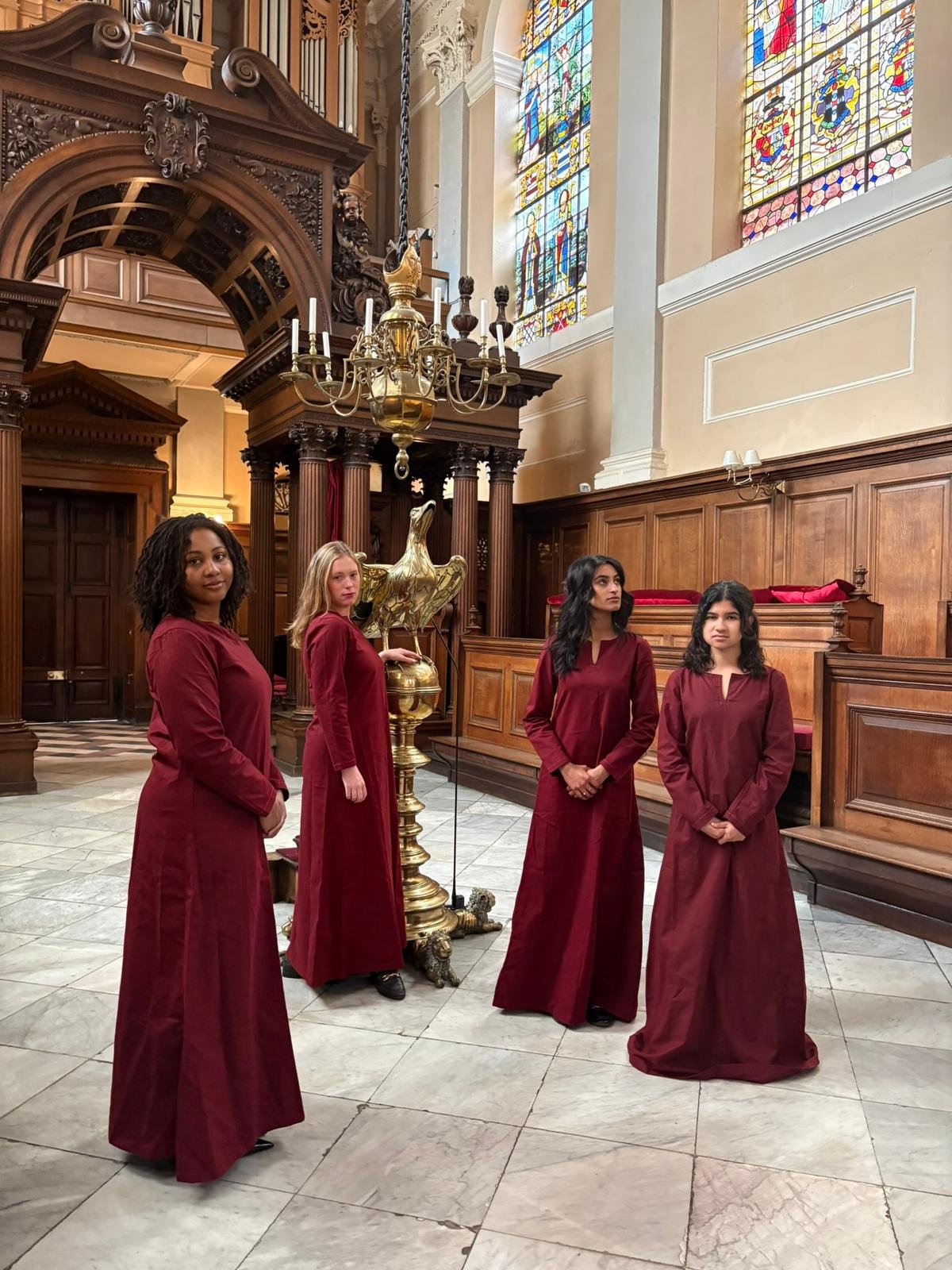
“Ospedale”