Intervu Rafi O’Neill
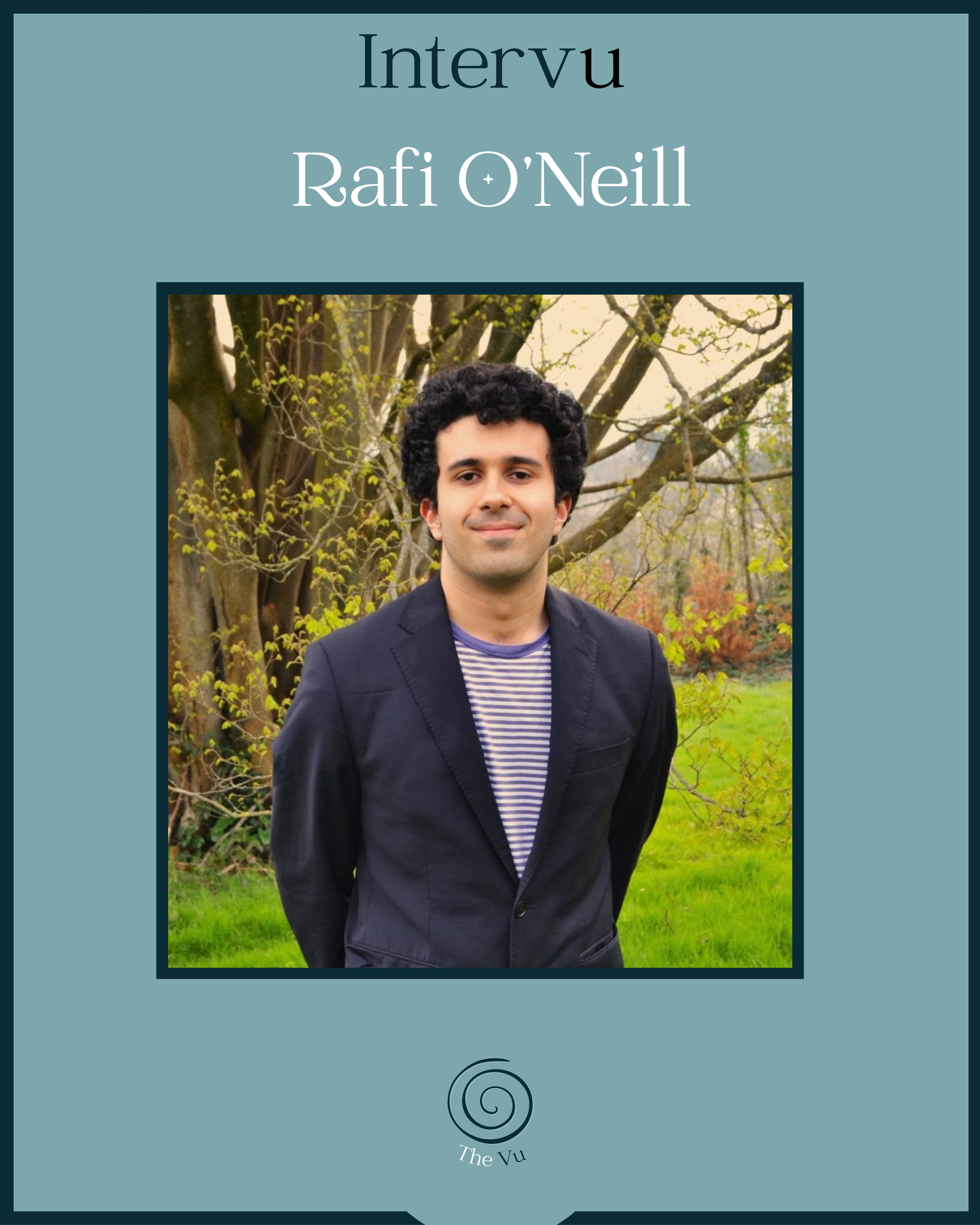
Rafi O’Neill
I sit down with Rafi O’Neill, an aspiring writer in his 3rd year at the University of Exeter, to talk about his work so far, what inspires him, and his future writing plans.
“I’m very much aware that you shouldn’t make what you love into your job - too much! I have a lot of friends who took English and have just stopped reading for fun. I think in short: I’ve taken history instead of English so I could read more!”
Rafi tells me about himself. He studies history but has aspirations of moving into a more literary and creative focussed career. I ask him if his history studies are something he incorporates into his work?
“I think less so history wise. I’m a very big reader. I love reading poetry and love reading modernist and post modernist literature - I see my writing as an extension of that. Writers like George Bataille, William Blake, Thomas Bernhard - I seem to like writers whose names begin with “B!” He tells me animatedly.”
“But I find that I like to explore a lot of the ideas I get from my reading through theatre, I think it has a very unique way of letting you look at ideas and display them to people. But I definitely use some history stuff in that. I set a lot of my plays in the recent past, like the 90s or 2000s. It's often easier to write about a time period once you’re a bit divorced from it.”
I ask him what he has been up to recently?
“I recently directed a 48 Hour version of Shakespeare’s “As You Like it” - which was really fun. We moved the setting from the forest of Arden to the Urban Jungle. And that was really, really fun. It was nice to go from writing, to assistant directing, some stage managing and finally going into directing with a text I knew really well, and doing it over a 48 hour period was really fun. Taught me a lot about not only company management, about directing skills and how to work with a text that wasn’t mine or by a person who I knew.”
I ask him if there is any particular theme or idea that he finds crops up a lot in his work?
He pauses.“I’ll take a second to think…” Then he begins: “I’m really interested in exploring people who feel a bit of adrift from society. I think the character of Rosalind in “As You Like It” is a really fantastic one of them, but a lot of characters in “As You Like it” are people who have been excluded from the court in society and find refuge in the forest. And that’s a theme I really like to explore are people who feel isolated and how particularly through subcultures but also through artistic expression, how people find meaning through that.”
He goes on, saying that “It ties into a lot of my own experience growing up in a white majority area as a non white person but also I’m really interested in- I like anything that balances both comedy with something darker and more felt - I think that’s a really beautiful thing.”
I ask him what he wants people to take away from his work?
I think - That’s a really good one! - What I’m hoping people take from it…” He pauses.
He begins again, “Because in a lot of my plays I like to explore themes like death and memory and art…a lot of the writers I really value take people to places they would not choose to go themselves almost like looking to areas that might be too dark or ideas can be often too difficult to express, without going too graphic but looking at things that make people a little bit uncomfortable and doing it through theatre in a way that makes it accessible but also makes people feel safe.
So I guess I want to challenge people but in a way that isn’t going to be too demanding. That’s what I’m trying to do with the current show I am writing: “Sun Dog”
On that note, immediately, I ask him about Sun Dog?
“It’s a show about one man’s life. It’s being written by me and I’ll also direct it for the Exeter Term 3 Festival. I’ve got a lovely cast and I’m currently finishing it off. It’s about a man who in the first 30 seconds of the play dies on stage and it’s his life told from the point of view of his family. He was a bit of a nothing father and was in a loveless marriage. It’s looking at how we never really understand people fully, we have our ideas created of people.” He tells me.
“I’m a big fan of Marcel Proust and he had this idea that our ideas of people are as much creations of ourselves - as them. It’s exploring the memory of this person through his wife, his sister, his son and his daughter and how they had completely different understandings of him. I’m hoping to explore ideas of death, memory, time - again, that sounds quite heavy but I like to lace it with humour and a lot of irreverence and keeping it accessible. And I think that’s something theatre is good for, you can present really big ideas but you can do it in a way that is A, because it’s more of a passive medium for those who are watching, keep it accessible but also make it your own, you can bring character into it, you can bring real people into it without just spouting philosophy to people.”
He chuckles, “I don’t want to upset anyone, that’s the first thing. The play I did with Theatre with Teeth, “The Lives and Works of Maeve West” I think I was very happy I was able to spook people a bit and make them a little uncomfortable. I don’t think particularly my ideas are anything new but I think I can present them in a way they haven’t been presented before and make people reconsider certain aspects of their lives, society and the world. That’s something that maybe I’m only 50% of the way there but I want to get to. I want people to enjoy what they’ve watched as well. I think there’s something to be said about any entertainment that you can enjoy but you’ve also taken something away from it, you may be reconsidering something, so blending the informative with entertainment.
I ask him if there’s anything that he is looking forward to?
“I’m very excited that I’m going to be seeing a new version of Arthur Miller’s play “Broken Glass” in London. That really excites me. They’re deliberately trying to take a play that was written about the holocaust but move it to a setting that feels more unfortunately relatable today. I find it very interesting how that theatre in particular gets adapted and reappropriated for different periods of time.”
“I really love the Term 3 Festival at Exeter. I think it’s a really lovely display of talent and seeing all of my friends work. It’s a nice community of people that is very rare in a university setting where you can see shows put on by people you know and you have a really nice opportunity to talk to them about their ideas.”
“I’m also very excited as theatre is something I’ve come to quite late in my university life and I really want to start going to see more up and coming theatre shows, hoping to go to Camden Fringe this year and just to see what else is being made my young creatives and how that’s shaping the way that theatre in the modern day is being created.”
I ask him if he has any advice for another creative?
“The first thing for me is to not let yourself hold back, I think the best advice I was ever given was “don’t listen to the voice in your head” because there’s a tendency to self edit and to think “Oh well, this isn’t quite working.” Writing it is the hardest thing.” He advises.
“What I find is I will write a bad first draft and that is often the hardest part. But you have to write a bad first draft to write an okay second draft to write a decent third draft and a good fourth draft - usually it takes fourth drafts for me. But I find with the bad first draft I take 70% of it, its just the 30% that I do change is actually where all the meat of the play is. So I think being willing to write stuff you don’t think is particularly good.”
“Something I’ve struggled with a bit before is not being as confident in my work even after writing it. If you can’t be confident at least feign confidence in it. But also in terms of getting things staged, I was very lucky to have Theatre with Teeth who were willing to take my work but just looking for any opportunities no matter how small and trying to build on that.”
“So that’s what I’m trying to do, I’m always on the lookout for new things that I can do.That’s scary. As I’ve almost done pretty much everything that I can do within university with the tools the University of Exeter will let me do, I really want to see if I can help other people develop their work during my masters Also, I’m looking to, hopefully maybe with a few friends, take a play to Camden Fringe - that’s something I’d love to do. I think it's the step beyond there to try and break into the industry is something I will wrestle with for my 20s.”
“But I think also I’m looking to make more connections and meet other people who are a bit further ahead. And also I’ve stage managed a lot of things and acted in a few things and I’m very happy also to work with other people and help other people. Because the wonderful thing about theatre is that its a collaborative process and although it can be fun to be the writer or the director or the creative at the top, I think it can be as rewarding working in the production.”
“A lot of my friends sometimes forget that I don’t study english or drama. There’s a few things, weirdly a lot of the literature I really like is not in the english language - and that’s probably another piece of advice I’d give to writers - you’re kind of restricting yourself if you’re only reading english language plays or novels.”
“There’s so much from other traditions, particularly for me, from French writing, German writing, Latin writing that I have drawn.”
“And they do things in different ways to what most writers do in English that I think people could learn a lot from. But beyond that, I do love history and I’m very much aware that you shouldn’t make what you love into your job - too much. I have a lot of friends who took English and have just stopped reading for fun. I think in short I’ve taken history instead of english so I could read more!”
I ask him what is next?
“I think I'd be looking for…I mean either “Sun Dog” or “Maeve West” I’d be very happy to take…but I almost feel like with every play you write you improve.”
“My first play “Maeve West” was 75% of where I wanted to be, then “Sun Dog” probably 85%. Maybe with a play for Camden Fringe I might get a play that gets to 95%. I’m lucky with history that although it's a very formal degree, it allows me to work in my own time. So for example I’m writing my dissertation while I’m editing the play “Sun Dog” and when I do my masters it will be even more of that.
Rafi’s instagram page can be found here: https://www.instagram.com/rafimostlikely/