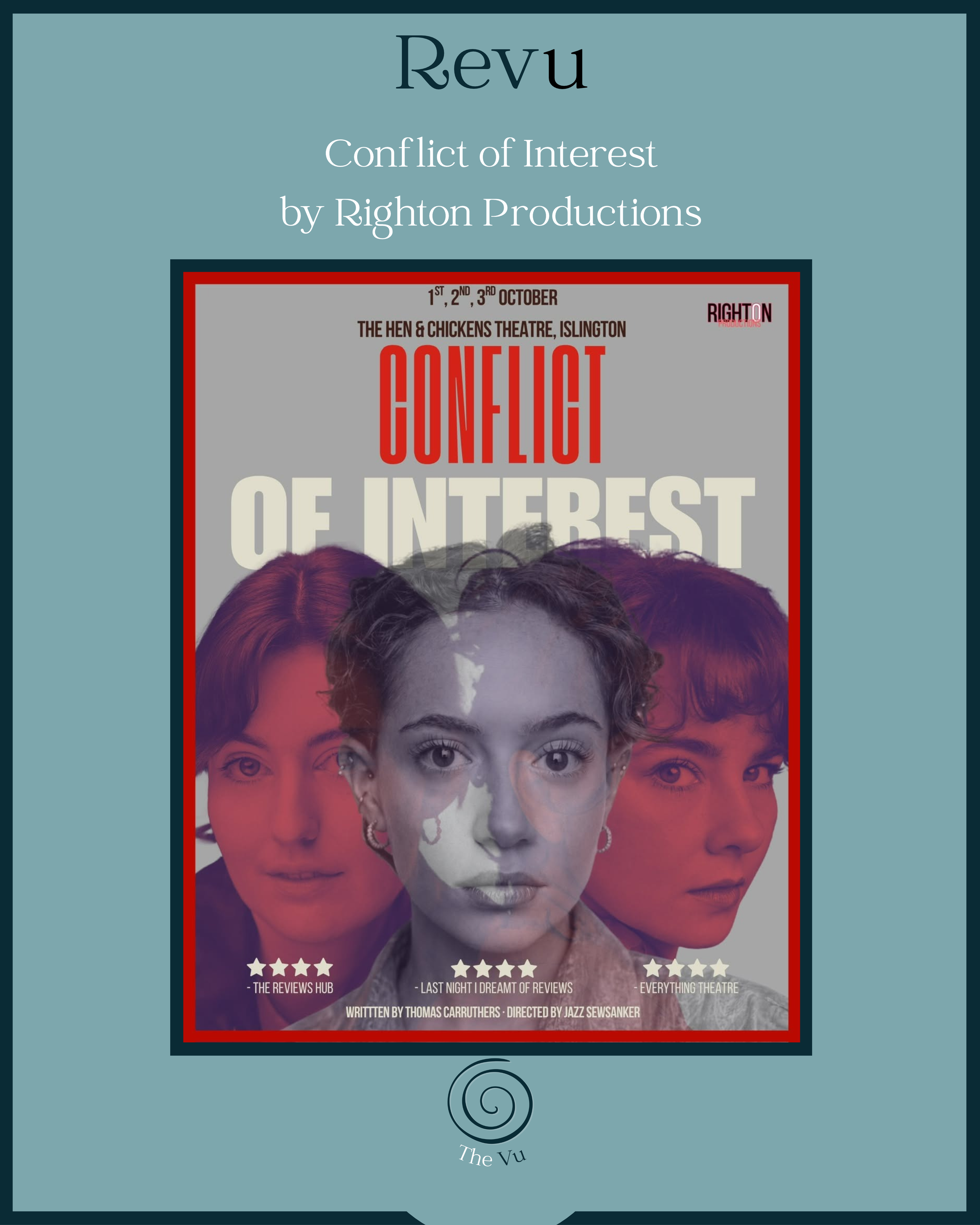
“Conflict of Interest” Poster
Righton Productions returns to London with its anticipated ensemble debut.
In March, I reviewed Righton Productions’ hilariously dark Are You There, Mother?, a one-man show written and performed by Thomas Carruthers. Ever ambitious, this time Carruthers returns as part of an ensemble cast of five, with a run time of 2 hours 25 minutes. I was delighted to see two successful and varied productions from the company in under a year, this time with an audience full of returning fans.

“Conflict of Interest”
Conflict of Interest is a legal drama set at Christmastime in 1980s Philadelphia. Arthur Carmichael (Thomas Carruthers) and Mitchell Hargrieve (William Leggetter) have inherited their fathers’ law firm and are renowned for proving the innocence of women accused of murder. Arthur’s first client, Lucy (Maeve Anne-Allen), was acquitted of her father’s murder and later became his wife. Ten years on, the appearance of a new client, Rita Lempkin (Rhian Holmes), seems like any other case. However, Rita’s pointed insistence that Lucy did kill her father becomes the catalyst that unravels both personal and professional lives. This play is about ruthless winners and disenchanted casualties. It has a strong plot and some really standout performances. Nonetheless, a few areas of the narrative require cross-examination in order to bring this story to justice.
The play’s opening effectively sets the scene. Arthur stands in court, offering his closing remarks to the jury (audience). This direct address is very engaging, and gives the impression that the audience will continue to judge the events that ensue. The majority of the next two hours is set in a grimly festive office. The costumes lean towards a naturalistic depiction of the eighties rather than caricature, though the clothes in Act Two give a stronger sense of the period. Given the play’s length and the detail of the cases discussed, the ‘case board’ showing the main case for each act was a nice touch.
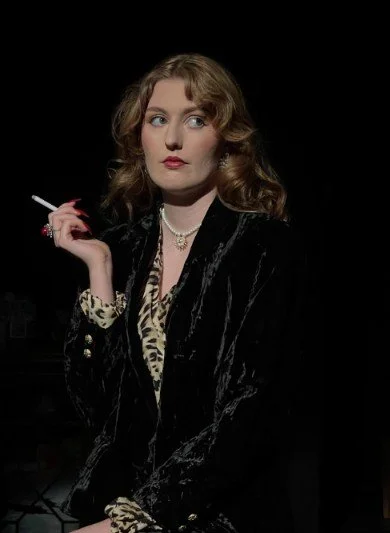
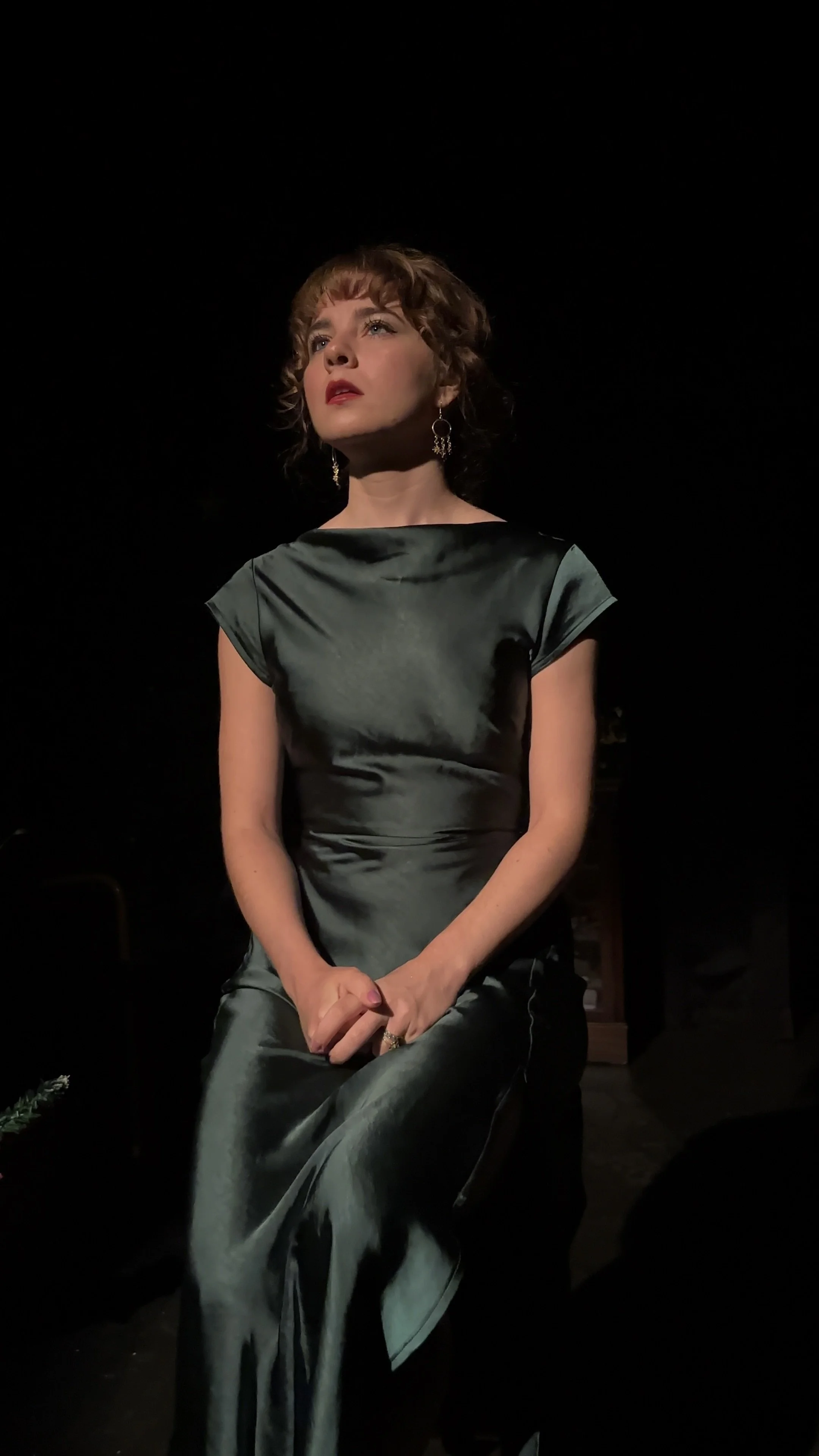
The set design is naturalistic and believably office-like, while the staging uses the entire space, stage door included, so the firm feels like part of a larger building. The actors inhabit the space fully, and their physicality not only brings it to life but also gives a vivid sense of character. Mitchell lolls and sulks at his desk; Talia Cooper (Amy Cash), the intern, hovers in corners and flits about; and Rita perches on a stool, as if on trial. Lucy and Arthur have some endearing moments as a couple, and both appear to ‘work the room’. Alone, Arthur is nervous and haggard. Carruthers’ complex female characters also allow the women in the cast to shine. Holmes’ performance is absolutely spectacular: she embodies the pushy southern belle with enormous stage presence.
The challenge of a play this length is to sustain audience interest, which is certainly upheld by the plot, characters and performances. However, some scenes are a little overlong. Tighter scenes at the end of Act One and in the middle of Act Two would allow a quicker, more engaging pace, as well as room to develop the key themes (sexism, toxic masculinity, the cost of corporate manoeuvres). Dialogue in the slower scenes often consists of long strings of insults, which neither helps the characters’ likeability nor contributes much to the plot. Fortunately, the piece picks up the pace again at several key moments, including Anne-Allen’s staggering emotional crescendo. Overall, the length of the play is justified even if the pacing occasionally slackens, with the rest of the evidence pointing towards a killer play.
“Conflict of Interest”

3.5/5 Stars

“Conflict of Interest”
By Ella Whybrow