Revu Dr Faustus
“Dr Faustus”
Friends know about my love for Shakespeare, Pinter, and Miller. Few, though, know that the first playwright I became bizarrely obsessed with was Christopher Marlowe. When I was 13, my first abysmal attempt at writing a full-length play was a biography of his life. This overconfident undertaking had been prompted after I read Marlowe's entire works (excluding Henry VI, which I suppose would now be included). My favourite was always Doctor Faustus.
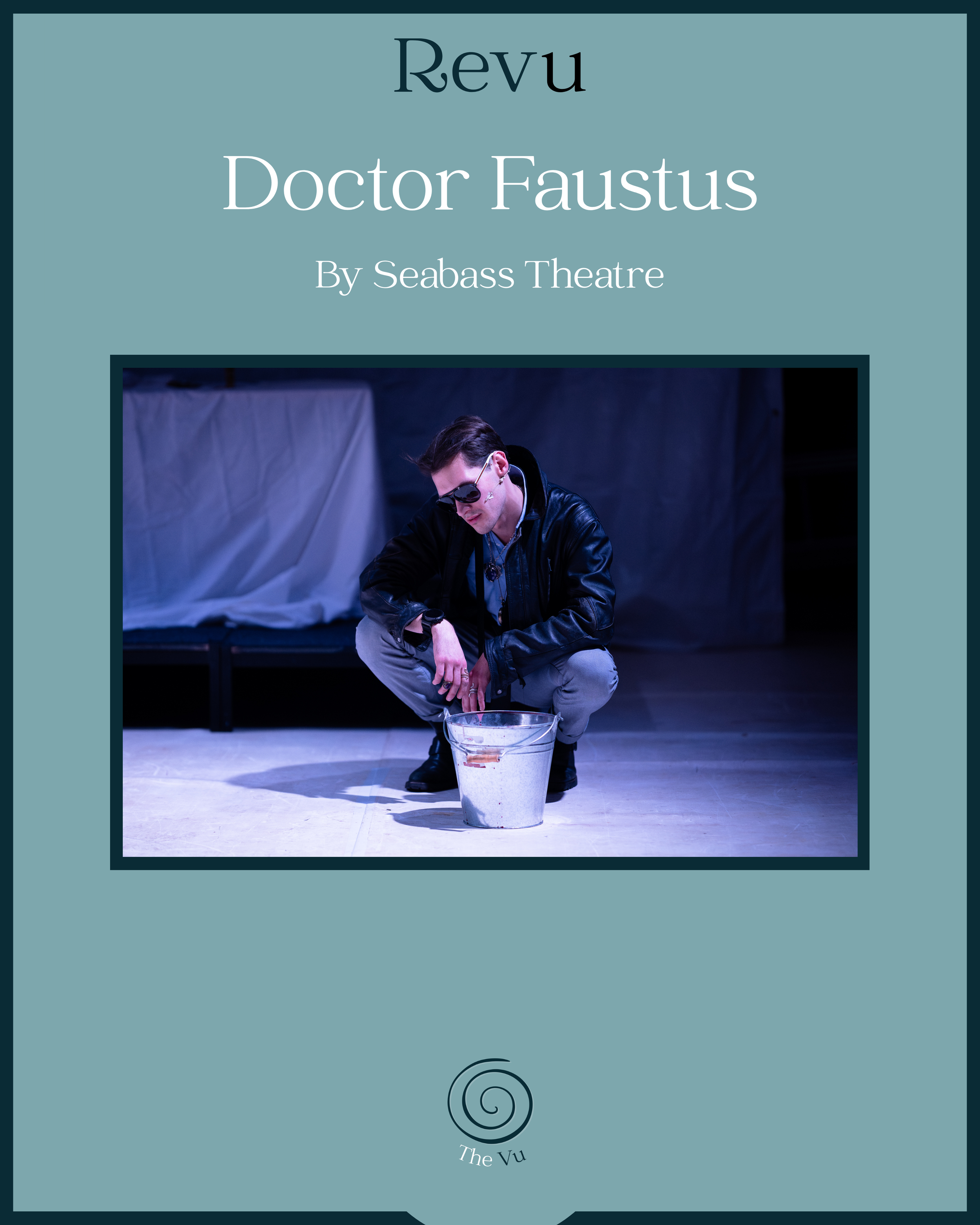
Marlowe's most famous play is an elaboration on the same classic Faust legend that Goethe later took on, about a man who sells his soul to the Devil. In exchange, Lucifer (Ali Khan) dedicates his demonic servant, Mephistopheles (Cameron Spruce) to Faustus (Paul Tomlinson), effectively giving him supernatural access to his every desire. Eventually, of course, Faustus must pay the price for his hubris, and is dragged to Hell ("thou must be damn’d perpetually!").
In Seabass Theatre's production, the sometimes comedic, sometimes bizarre scenes filling the space between the demonic deal and its final punishment have been revitalized and expanded upon with the help of new writing from director Seb Carrington and Lily Zhang. In fact, there are entire scenes and plotlines invented and told through modern language - purists will surely revile. Perhaps strangely, I actually don't mind this. The writing is strong and adds interesting dimensions to the narrative being explored, although it is a bit of a shock when everyone first starts chatting in current parlance.
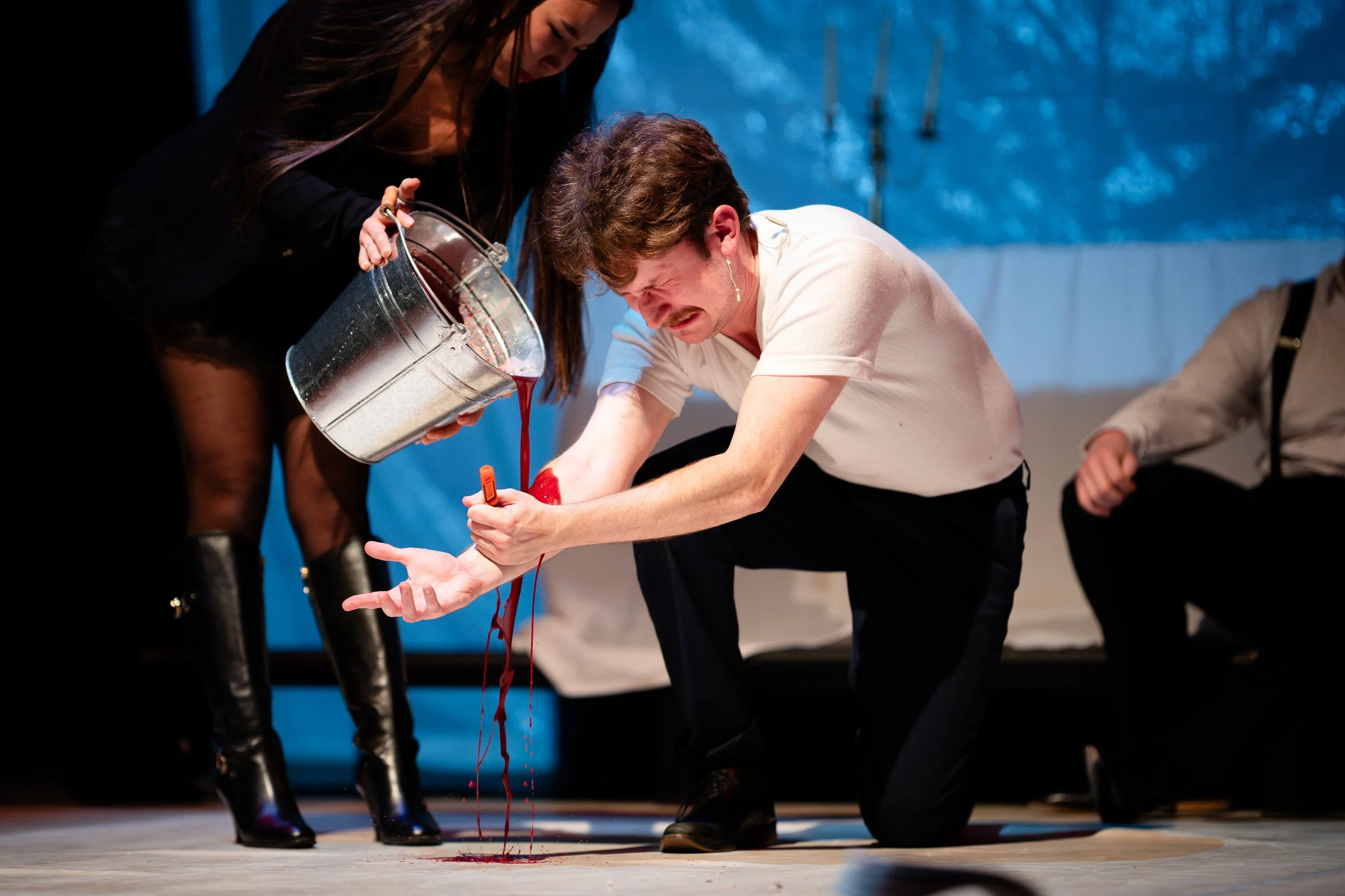
But then, "shock" is clearly what Carrington is going for. This is clear from her reinterpretation of one scene as an incredibly uncomfortable episode of sexual violence. It is exceedingly difficult to watch, but it forces the audience to confront what Carrington is impressing on us from the start, principally by combining the characters of the Woman-Devil, the Good Angel, and Helen of Troy (Amber Meeson) into a potent reminder of how Doctor Faustus abuses its female characters ("Here’s a hot whore, indeed: no, I’ll no wife").
But this is not just a feminist retelling, but a queer one as well. The relationship between Mephistopheles and his servant becomes physically, explicitly homoerotic, and Seabass even briefly allude to the contemporary political power of anti-trans language when Faustus delivers a speech utilising rehtoric against the "muddling of the sexes." This ties into a larger device of the writing which imagines Faustus as 'a distinctly fascist character' (Carrington in a Cherwell interview). This radical adaptation to contemporary political and social concerns works to Seabass's advantage, I think, at least insofar as it galvanizes the production towards unique polemical aims.
But this is a production defined by so much more than its narrative foci. Madison Howarth's choreography turns a difficult scene into a Berghain-esque movement sequence, and physical theatre is used to bring potent visual flair throughout. The famous final scene (when Edward Alleyn, the original Faustus, saw real devils coming for his soul alongside the actors seeking his character's) is also given a unique, perhaps anti-climactic treatment, which I suppose is intended to deny this rather vile character his typical "big finale" moment.
“Dr Faustus”
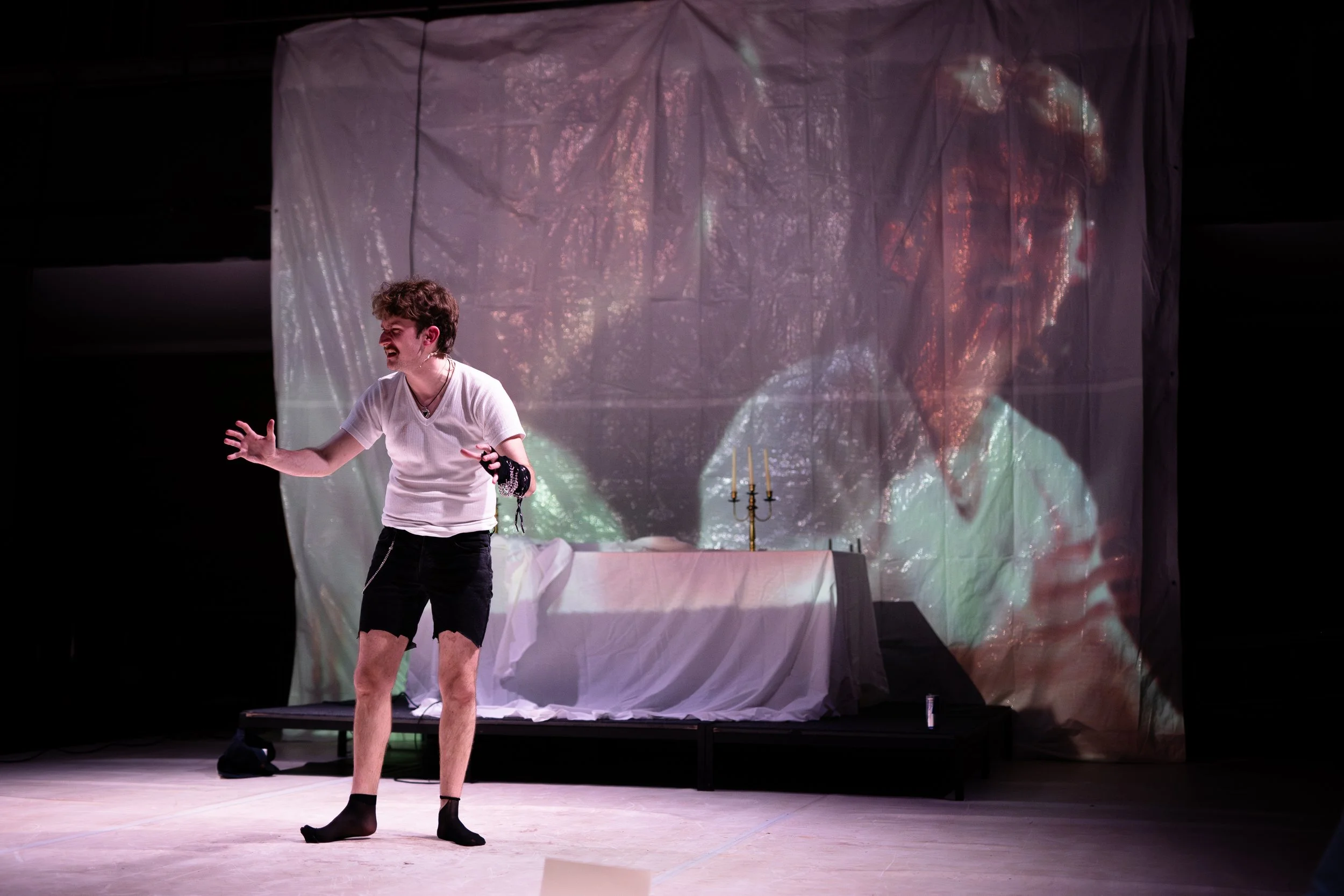
On the design side, there is equally much to talk about, beginning with Carrington's choice to bring the O'Reilly into thrust (it is clearly the week for it - Hedda Gabler and The Players did the same). I think this works, but of course we don't get the kind of intimacy the same staging achieves in the BT or Pilch. More impactful is Ben Tilley's lighting design, which utilises two huge overhead projectors and strobe effects to powerful effect throughout. These projectors are also used for multimedia storytelling, as video (including live footage from a camera used by the actors onstage) is frequently cast onto a huge white screen upstage. This technique proves successful for telling the story in a rich, multi-layered way, and reintroducing Marlowe's text when it has been cut from the spoken dialogue. An unfortunate consequence, though, is the constant humming of the fans required by these machines, which is more than a little distracting. I also generally enjoy EP Siegel and Yolanda Zhou's costume design, which turns Cornelius (Elizabeth Henderson-Millier) and Valdes (Anya Boranbay) into goth girls, and does much to clearly define this production's unique interpretation of each character.
More could be said about the range of interesting design and directorial choices Seabass have packed the O'Reilly with, but I must move on to the performances, which are almost universally strong. Despite a general problem concerning volume (not helped by whirring fans), this cast attacks and revitalizes iconic characters with clearly-conceived and energetic portrayals. Highly compelling supporting performances are provided by Khan, Maximillian Stecher, Oliver Perry Wade and Graham Reid. Khan's Lucifer is a suitably imposing presence, gloriously sadistic but somehow charming; Stecher brings a healthy dose of villainous flair and a palpable sense of danger to multiple roles; Perry Wade is truthful and convincing as Wagner; and Reid fully uses his characteristic skill for heightened caricature to create a Pope that is both laughably decrepit and genuinely nasty.
The story is no different with Faustus's iconic lead roles, as both Tomlinson and Spruce excel. Although the former sometimes struggles with diction and the latter with volume, they remain a formidable pair, from whom it becomes difficult to unfix one's eyes. Tomlinson's performance is genuinely manic as it bounces between self-pitying incel and crazed egotist, and his relentless energy does much to drive this complicated narrative forward. It can be balanced only by the controlled physical presence of Spruce, much more the power-broker-letting-his-client-off-the-leash-a-little than the submissive manservant.
Probably the highlight performance, though, is given by Meeson as the Good Angel, who is incredibly compelling and truthful in a number of gripping moments. Perfectly fulfilling Carrington's intentions to expose misogynistic impulses in Marlowe's script and the character of Faustus, she uses impressive physical and vocal skill to navigate complicated scenes and express everything from rage to agapeic forgiveness with considerable force. Seabass's production, almost with Artaudian Cruelty, hurls a huge variety of pressing visual images at its audience. Out of all of them, I think the one that remains in my memory will be the combination of pain, distress, and bravery embodied by Meeson.
Before I came to this show (having just tumbled out of bed and rushed to the matinee fuelled only by a couple of biscuits, the whole thing did feel like a fever dream, which I think is the intention), I was told that it was divisive, and I can see why. Seabass have crammed so many political dimensions, directorial innovations and bold design choices into their retelling that student critics inevitably have much to discuss (and either celebrate or condemn). Undoubtedly, many will feel that some choices are excessive or unnecessary, and I have no arguments against those people. But it also seems to me that this production is packed with exciting creative ideas and skilled performances. Yes, it's a mad mixture of Elizabethan tragedy, new writing, feminist retelling, queer retelling, contemporary political polemics, physical theatre, multimedia projection, strobe lighting and goths... but I think, somehow, Carrington and her team attack it all with such unapologetic fervour that they manage to pull it off.

4/5
Thanks are due to my friend Izzy Moore for the insights of our usual post-show chat.
Review by George Loynes
The link to George Loynes’s review blog is: https://roomwithreviewblog.blogspot.com/?m=1&fbclid=PAZXh0bgNhZW0CMTEAAadKaD9DWn-5mwBnPczPWh3KXF0Wm5MTE_D9WbXEiWAbpuhhg9yNdnyYWKaYSg_aem_MX4-paKRuQoHXi7vgFXpPw
“Dr Faustus”