Revu Noether
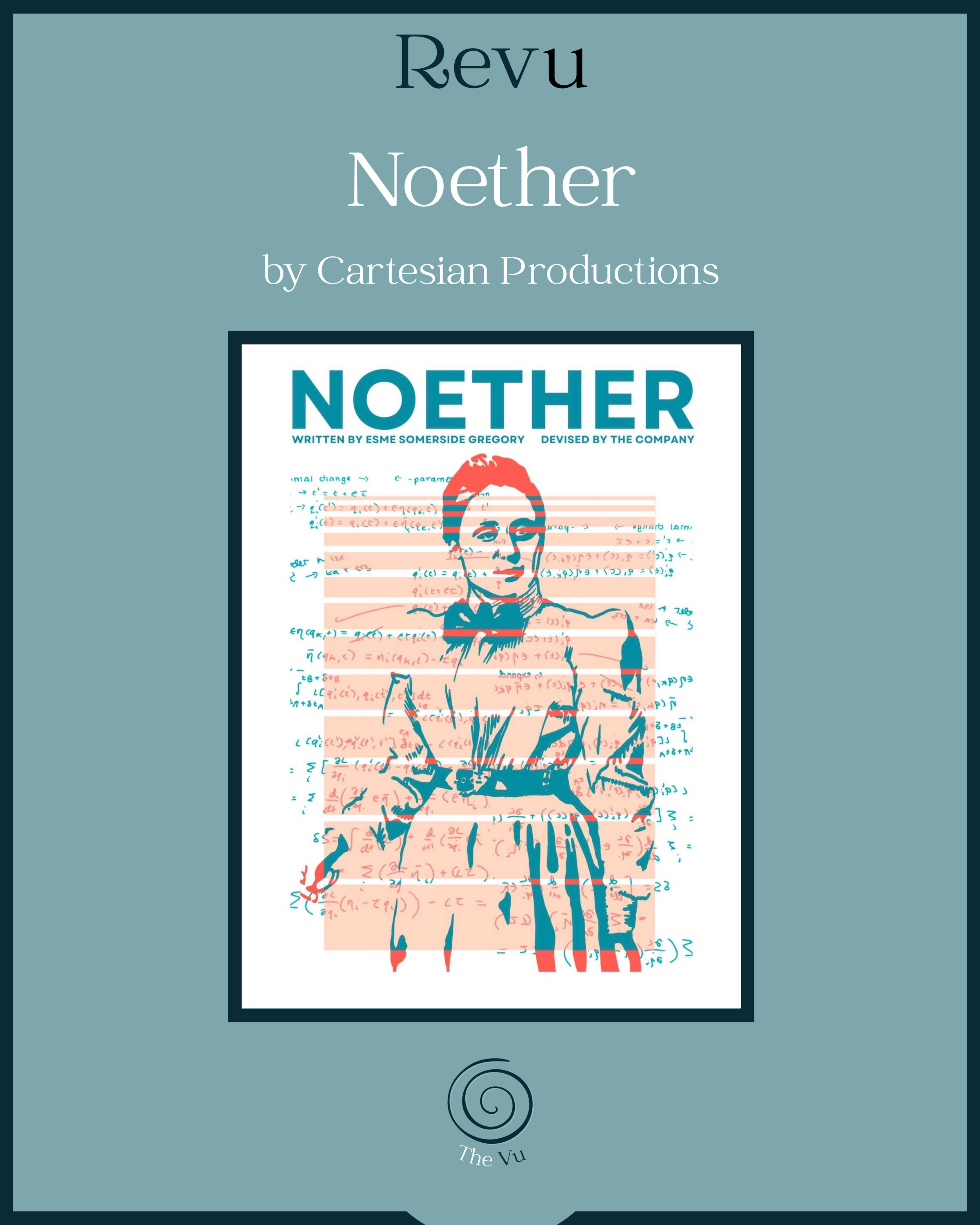
“Noether” Poster
There’s an old misogynistic joke from early twentieth-century maths circles. The joke goes: there are only two female mathematicians, one is not a mathematician, the other is not awoman. The first one was Sofia Kovalevskaja, a polymath who, besides her mathematical research, wrote novels and plays. The second one was Emmy Noether. In fact, Fraulein Noether was sometimes called Herr Noether during her life, her lack of womanliness seen as an honour.
This play covers the life and works of Emmy Noether, a mathematical genius who worked in the most prestigious maths institution of the twentieth century, the University of Gottingen, and collaborated with the likes of David Hilbert and Albert Einstein. It was set in a lecture theatre of the Mathematical Institute, letting the audience turn into almost students and witnesses to both Noether’s genius and the obstacles Noether had to face despite it. The author, Esme Somerside Gregory, builds a historically accurate and engaging biography, letting the audience feel Noether’s passion and rage about the limitations of the academic environment. The performance of Yael Erez is subsumed, measured and passionate, conveying the quiet dedication that Noether had to her discipline and to her students. And the rest of the cast contributes to putting on the stage the enthusiasm and rigour that is such an important and yet often forgotten part of academic mathematical research.
“Noether”
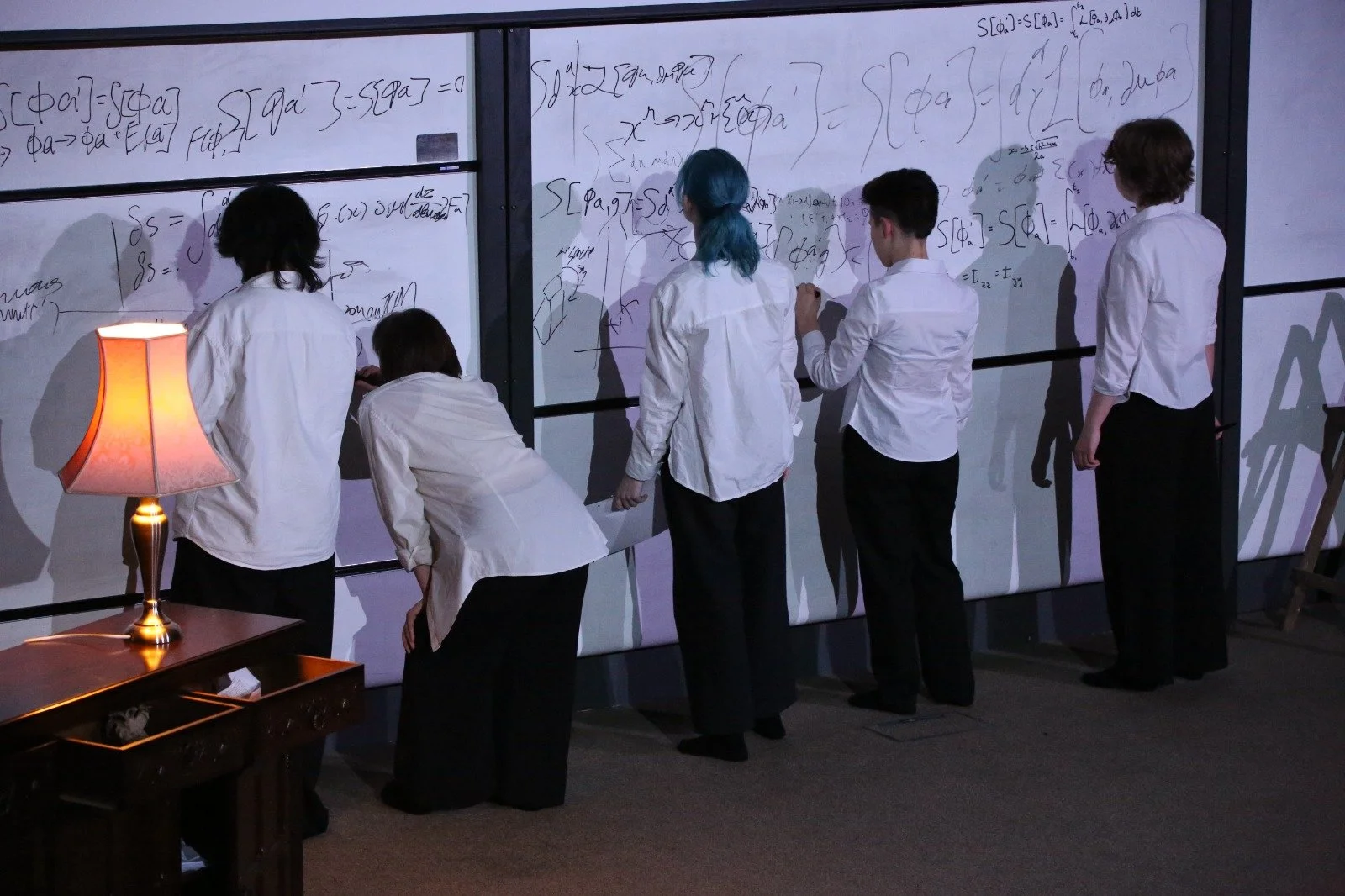
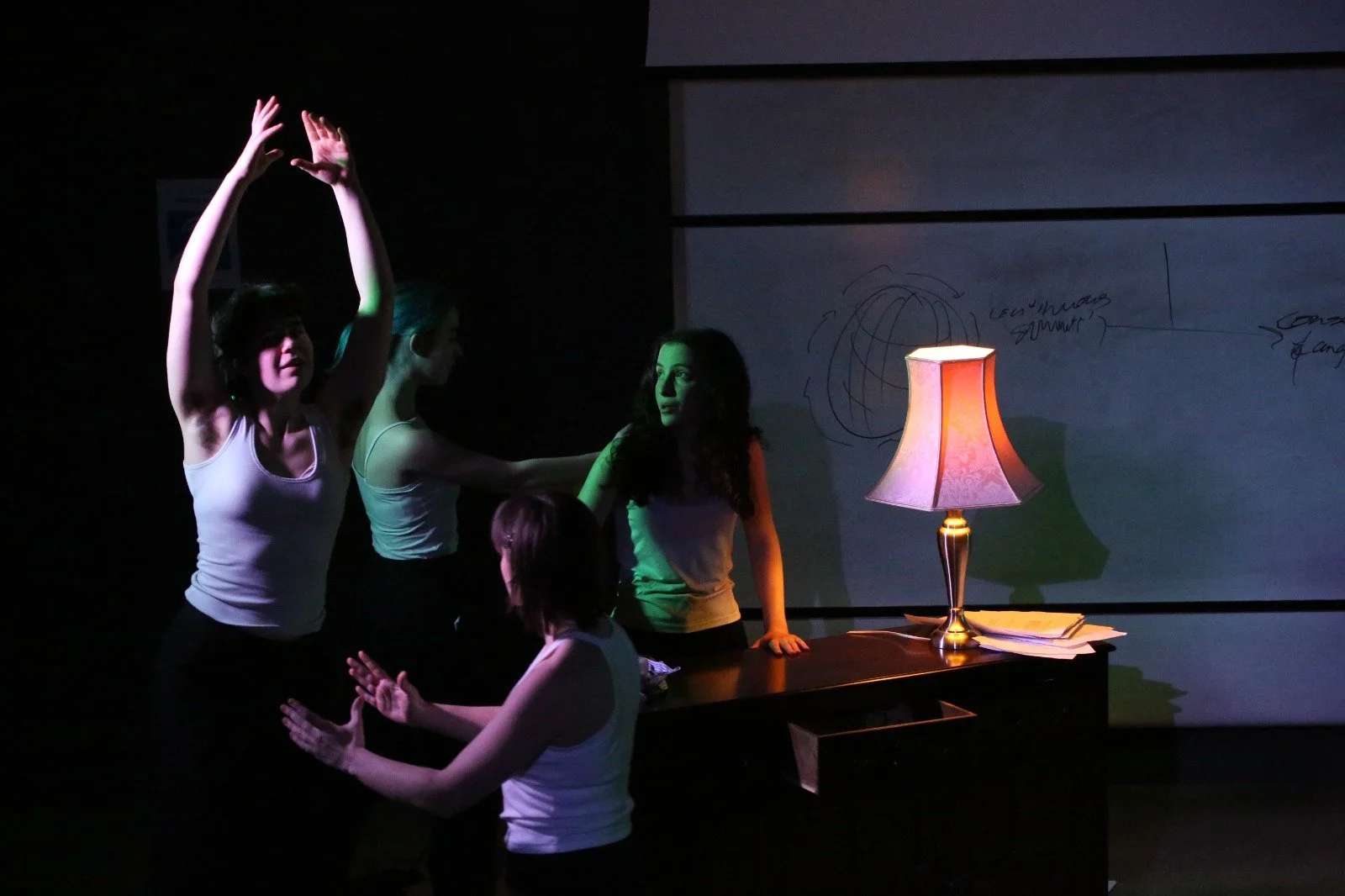
Noether was devised in collaboration with panellists and the Oxford Physics Gender Equity Network. We are greeted by a whiteboard that presents formulas both of group theory and differential equations. But how to convey such complex ideas to the public, especially given that maths and theatre don’t often meet? This production adopts a double strategy. First, a projector shows snippets of research papers and presents some visual animations echoing Noether’s research on symmetries in algebra. Secondly, and most interestingly, several sequences of physical theatre mimic the movements of symmetrical groups on spheres and squares. Esme Somerside Gregory designed this in collaboration with the cast: it’s an innovative usage of theatrical devices to convey abstract mathematical ideas without alienating the audience.
Had the play been longer, it’d have been interesting to delve deeper into the nitty-gritty of Noether’s research: how not only did she leave a significant trace pretty much everywhere in algebra, but she also contributed to the development of modern physics. For the non-mathematical reader, I can’t stress enough how impressive this breadth of contributions is. But, while as a maths graduate I wanted more theorems, as a reviewer I must concede that this play makes a wise choice in privileging the human aspect. Noether is presented not just as a mathematician but as a lecturer, dedicated both to her discipline and to her students. It shows that maths is a collaborative endeavour, only possible thanks to classes, conversations, correspondences. And this can only shine thanks to the great cooperation of cast and crew. The technical aspect of this play is perfectly suited to the story told, from a carefully designed stage to the creative usage of light and sound.
The play shines in the second part, when the shadow of Nazism starts to overwhelm Gottingen. This is when the choice of venue reaches its peak, a brown shirt looming in the back of the lecture and music getting louder while Noether attempts and fails to teach. This is also when the play turns from historical class to important memento for today: in an age where human rights get confiscated at concerning speed, Noether invites the audience to consider how politics intrudes and shapes academic research. Sitting in the lecture theatre with the cast and crew, the audience can’t help but feel implicated. The depiction of antisemitism was disconcerting yet timely, powerfully portrayed with the help of sensitivity coordinator Tilly Jackson-Long. Eventually, Noether abandoned Gottingen for the US, where she spent the last years of her life and career. Yet the play ends on a hopeful note, showing an academic genealogical tree with the generations of mathematician Noether brought forth.
The illusion of subjectivity in reviews is a tough one to keep. I saw firsthand the remnants of the misogyny that stifled Noether’s research. If circumstances have improved in today’s academic environment, if I were allowed to sit in a lecture theatre and see brilliant female lecturers in my department offices, if this play could be brought to life, it’s thanks to figures like Emmy Noether. This production knows just how timely this story is and masterfully combines theatrical devices and mathematical expertise to bring it on stage. Here’s to hoping that it’ll set a fruitful thread of theatre exploring scientific ideas.

4/5 Stars
“Noether”
Review written by Jude Parrotta